
When Safe Assets Stop Looking Safe
Why geopolitical fragmentation is quietly redrawing the map of global reserve assets — and what it costs America when nations stop trusting the system it built.
For decades, the answer to crisis was simple: buy Treasuries.
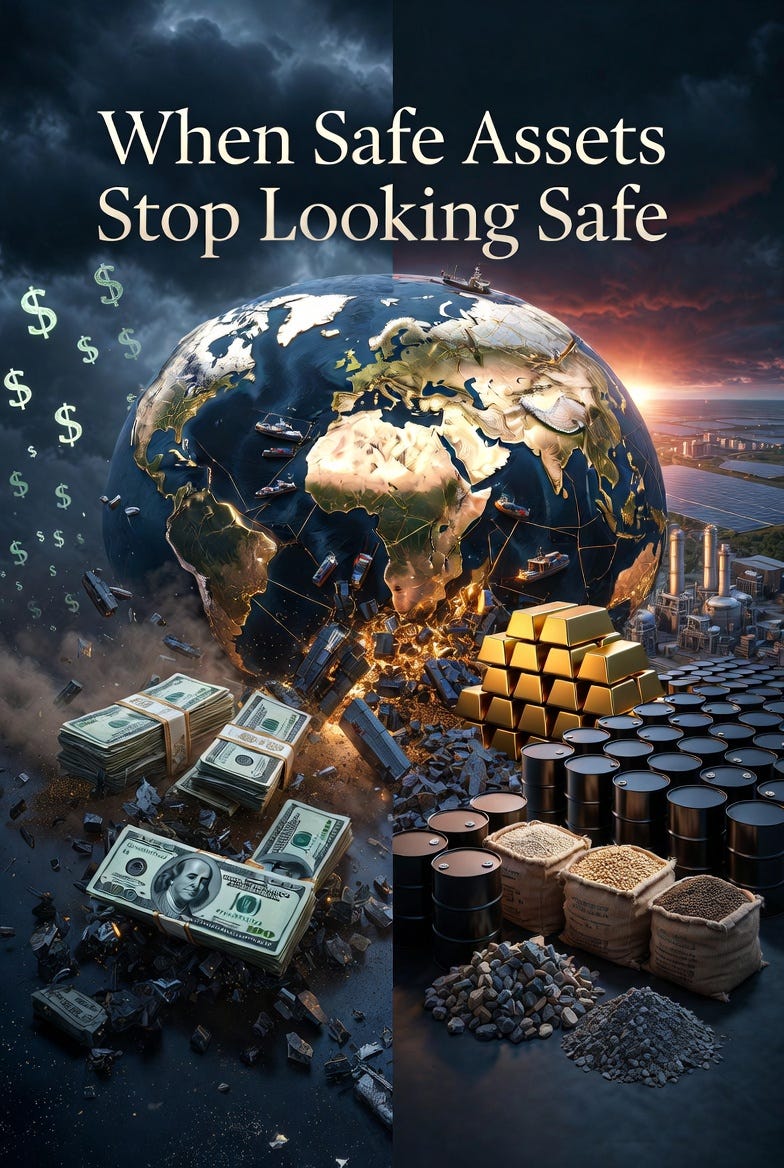
Nations accumulated U.S. dollars and Treasury securities because the system rewarded it. If energy prices spiked, if supply chains seized, if currencies wobbled, you sold Treasuries and bought your way through it. The logic was circular and self-reinforcing. Everyone believed it because everyone else believed it. That belief was the asset.
It is starting to unwind. Not because the United States is collapsing. Because the world is fragmenting. And in a fragmented world, the thing that protects you is not a pile of financial assets. It is a pile of the actual inputs your economy cannot survive without.
Are there choices?
The emerging problem is not financial risk. It is resource insecurity.
Countries are beginning to realize that financial reserves alone may not protect them in a world where access to fuel, fertilizer, industrial materials, shipping lanes, and critical commodities can become politically constrained overnight. The recent escalation involving Iran did not cause this shift. It exposed it.
South Korea imports more than 90 percent of its energy. It ranks as the world’s third-largest importer of liquefied natural gas. It imports 85 percent of its foodstuffs. Fertilizer inputs? Foreign supply. Industrial minerals? Foreign supply. In a fully globalized world, none of that was a crisis. It was just efficiency. Just-in-time at national scale.
But efficient systems are fragile systems. And the geopolitical environment is no longer reliably open.
Australia sits on enormous natural resource wealth and still remains structurally dependent on imported refined petroleum products, particularly diesel. India imports massive quantities of energy and fertilizer inputs needed to sustain both growth and domestic stability. The pattern repeats across the middle tier of the global economy: resource-adjacent countries that built their development models on the assumption of accessible global markets now have to reckon with what happens when those markets become conditional.
When access becomes conditional, the definition of national security changes.
And when the definition of national security changes, reserve behavior changes with it.
Instead of accumulating financial assets that can be liquidated to buy physical ones, countries increasingly have reason to accumulate the physical ones directly. Strategic fuel reserves. Fertilizer stockpiles. Food security programs. Domestic refining capacity. Mineral inventories. Long-duration infrastructure that produces rather than merely stores value.
This is not speculation. Central bank gold holdings globally passed total foreign official holdings of U.S. Treasury securities by market value in late 2025. That is a data point, not a narrative. The dollar still accounts for roughly 57 percent of allocated global reserves. But foreign ownership of U.S. Treasuries as a share of total outstanding debt has fallen from above 50 percent during the financial crisis to roughly 30 percent by early 2025, reflecting both exploding U.S. issuance and gradual reserve diversification. China has reduced its holdings by nearly half since 2013. India cut its Treasury exposure by 21 percent in fiscal 2025 alone. These are not accidents. They are policies.
The thesis that de-dollarization is driven purely by geopolitical grievance misses the deeper mechanism. It is not simply that countries distrust Washington. It is that they are running a different calculation about what a reserve asset is for.
In a stable, open global economy, the answer was liquidity. The ability to sell an asset quickly and buy whatever you needed.
In a fragmented, contested global economy, the answer may be something else entirely: physical security of supply. Which cannot be provided by a financial instrument, however liquid.
A trillion dollars in Treasuries does not help if fertilizer shipments stop, shipping lanes close, or fuel supplies become politically contingent.
The inflationary consequences flow directly from this logic. A globalized world minimizes redundancy by design. Nations buy what they need when they need it. A fragmented world maximizes redundancy by necessity. Nations stockpile what they might need regardless of current price. Multiply that dynamic across a sufficient number of economies and you generate structurally higher baseline demand across energy, food systems, industrial inputs, and shipping capacity.
The country helping generate this instability may also absorb a disproportionate share of the inflationary cost. The United States remains one of the largest consumers of globally sourced industrial materials, manufactured inputs, and rare earth processing. The supply chains being disrupted are, in many cases, the same ones the American economy depends on.
The energy transition complicates this further, but not in the direction that optimists assume.
Oil dominance historically reinforced Treasury demand because global petroleum trade largely operated through dollar systems. Future energy growth increasingly includes distributed domestic generation: solar, localized storage, regional grids, and eventually small modular reactors. These systems reduce dependence on globally centralized fuel flows over time. That weakens one of the historical structural pillars underneath dollar dominance. The transition will take decades. The directional pressure is already visible.
And the war is accelerating something the transition alone would have taken a generation to accomplish: oil-producing nations are actively building payment infrastructure that bypasses U.S. financial systems entirely. The petrodollar did not require a policy decision to construct. It may not require one to dismantle.
A world allocating more capital toward strategic stockpiles and less toward financial reserves is also a world where the United States faces structurally higher borrowing costs. Reserve diversification does not need to collapse Treasury markets to matter. Marginal reductions in foreign demand, sustained over years, are enough to place upward pressure on yields inside an already debt-heavy fiscal system. Higher yields mean higher debt service. Higher debt service inside an expanding deficit means less fiscal room. Less fiscal room means harder choices about what the government can afford to do. And inflation does not reverse — it compounds. Prices that rose establish a new floor. The question is never whether they come back down. They do not. That chain is not hypothetical. It is arithmetic.
There is a certain irony worth naming. If the effect were to weaken long-term confidence in the dollar system, this would be an efficient way to do it.
And there is something else that belongs in this accounting.
The strategic miscalculation that helped trigger the current escalation was not simply geopolitical. It was analytical. The assumption, apparently, was that conflict would be contained, brief, and manageable. Two weeks, maybe three. Volatility absorbed. Markets stabilized. Mission accomplished. That is not what happened. What happened instead is what always happens when a complex system is pressured without a theory of the whole: the consequences spread laterally into domains no one was tracking. Energy markets. Fertilizer prices. Shipping insurance. Reserve calculations in capitals that had nothing to do with the original decision.
A country that cannot accurately model the second-order consequences of its own military decisions is not generating leverage. It is generating liability.
For itself and for every economy that built its stability assumptions around American reliability. Capital allocated to warehoused diesel and fertilizer reserves is capital not building schools, power grids, or research capacity. Every barrel stockpiled is an infrastructure project that does not happen, a workforce that does not get trained, a productivity gain that does not compound. The only actors who benefit cleanly from a world organized around physical hoarding rather than open trade are the ones selling the resources being hoarded. Everyone else pays the friction cost. Including the United States.
So who decided this was worth it?
Here is what is actually being chosen, and by whom.
Washington has adopted a foreign policy posture built on unpredictability. But calling it a strategy gives it too much credit. What the evidence actually shows is a disposition — reactive, improvisational, answering the last provocation rather than pursuing a durable theory of American interest. The cost is the same whether the chaos is intentional or not: every nation watching updates its calculation about whether a dollar-denominated reserve is a safe asset or a political exposure. The difference is that a strategy can be negotiated with. A fumble cannot.
Reserve managers in Seoul, Mumbai, and Brasilia are choosing to treat physical commodities and domestic production capacity as national security investments. That is not de-dollarization as ideology. It is de-dollarization as risk management. The distinction matters because ideology can be negotiated. Risk management runs on its own logic.
The alternative that is not being chosen: a credible, coordinated international framework for resource access that gives trading partners reason to believe open markets will remain open under stress. That would stabilize the calculation. It would reduce the incentive to stockpile. It would slow the structural drift away from financial reserves toward physical ones. It would require sustained, patient diplomatic investment in the kind of multilateral institutional credibility that takes decades to build and can be dismantled in a single budget cycle.
That is the choice not being made.
So what are the choices?
What is being made instead is a world that is slowly, structurally, non-cyclically more expensive. Not because a war happened. Because enough governments simultaneously concluded that they could no longer trust the global system to be there when they needed it.
Once nations begin stockpiling survival itself, the global economic system does not temporarily inflate and recover. It reprices permanently.
The dollar is not disappearing tomorrow. But the logic that sustained dollar dominance is eroding, and the decisions accelerating that erosion are not being made in Beijing or Moscow. They are being made in Washington.
A note outside the analysis.
There is a version of this story that tells itself as restoration. That deglobalization is a return to something that existed before — a more sovereign, more self-sufficient America. It is worth remembering what it would be a return from.
The last eighty years produced the greatest sustained reduction in global poverty in human history. More people climbed out of destitution during the postwar era of American-led international cooperation than in any comparable period on record. Not because markets are magic. Because trade, institutional trust, and shared frameworks of interest created the conditions in which markets could function at scale across borders. The United States did not benefit from this by accident. It designed much of the architecture and reaped the returns — in exports, in capital flows, in the privilege of issuing the world’s reserve currency, in the soft power that came from being the country others wanted to partner with.
Deglobalization does not return America to greatness. It returns the world to the conditions that made greatness feel necessary in the first place — scarcity, zero-sum competition for physical resources, and the logic that produced the conflicts the postwar order was built to prevent.
The world became safer not because America was unpredictable. It became safer because, for a time, America was reliable. Because cooperation, trade, and common interest turned out to be more durable compounders of human welfare than any single nation’s dominance ever was.
That is the asset being spent. And unlike Treasuries, it cannot be reissued.
There are always choices.
If you value this kind of analysis, share it. Your support makes The Cerf Report possible. And if you haven’t already, subscribe. Visit TheCerfReport.com, follow @TheCerfReport on Substack/X/BlueSky.
Likely your best article yet. And the chasm between the haves and the have nots only grows wider.